August 10, 2026
FortlocBlog
June 2026
Boat International, June 2026 — Cecile Gauert — Business partners and co-founders of The Twenty Five, Neill Etheridge and Jamie Petty are UK transplants living in the Northeast of the US. And like nearly everyone living a high-paced life in this congested area, they have experienced the frustrations of long commutes. The roads are clogged, the airways congested and helicopters are expensive and not always seen as safe. If only there was a better way to get from point A to B. It was that very same concern that had Wall Street bankers build commuter boats to get to and from Manhattan in years past.
The partners began exploring various avenues to address the issue until a Google search two and a half years ago led them to a Rhode Island-based company named REGENT trying to launch the next phase of maritime transportation.
“We stumbled across the REGENT technology, which is the Seaglider,” Petty says. “We popped up there to check that it was real. And we were pleased and surprised that they had a wooden full-scale model but also had a one-quarter [scale] model that had proven the technology.”
By then it had been three years since CEO Billy Thalheimer and co-founder and CTO Mike Klinker, both MIT graduates, had embarked on the adventure of launching a new all-electric flying boat for speedy, quiet and sustainable coastal transportation — “the first new mode of transportation since the helicopter,” as Thalheimer points out.
The two were perfectly suited to the task. “I am aerodynamics and aircraft design, he is more software and autonomy, so between the two of us we could build an airplane,” Thalheimer explains. “We were both working at a Boeing subsidiary building airplanes, then we’d go fly airplanes in our spare time. I was a competitive sailor in college. He grew up a lobster fisherman. So we had all this experience and we said, ‘Let’s bring all this technology and bring it into the maritime world.’”
They came up with the idea for a fully electric foiling boat able to fly up to 12 people at the time. Their idea appealed, and they got serious backing from the likes of Mark Cuban, Peter Thiel, Steve Cohen, Lockheed Martin and Japan Airlines, among others. A well-funded startup, they have raised more than $100 million to date and have reached the prototype stage for their flagship 15,000-pound Viceroy Seaglider. They have been testing it on the water and recently broke ground on one of the largest commercial buildings yet built in Rhode Island where they will be manufacturing their craft.
“The Seaglider creates a new mode of transportation that is simultaneously faster, more comfortable, more sustainable than any of the vehicles we have now,” says Thalheimer, the inventor of the unusual-looking vehicle.
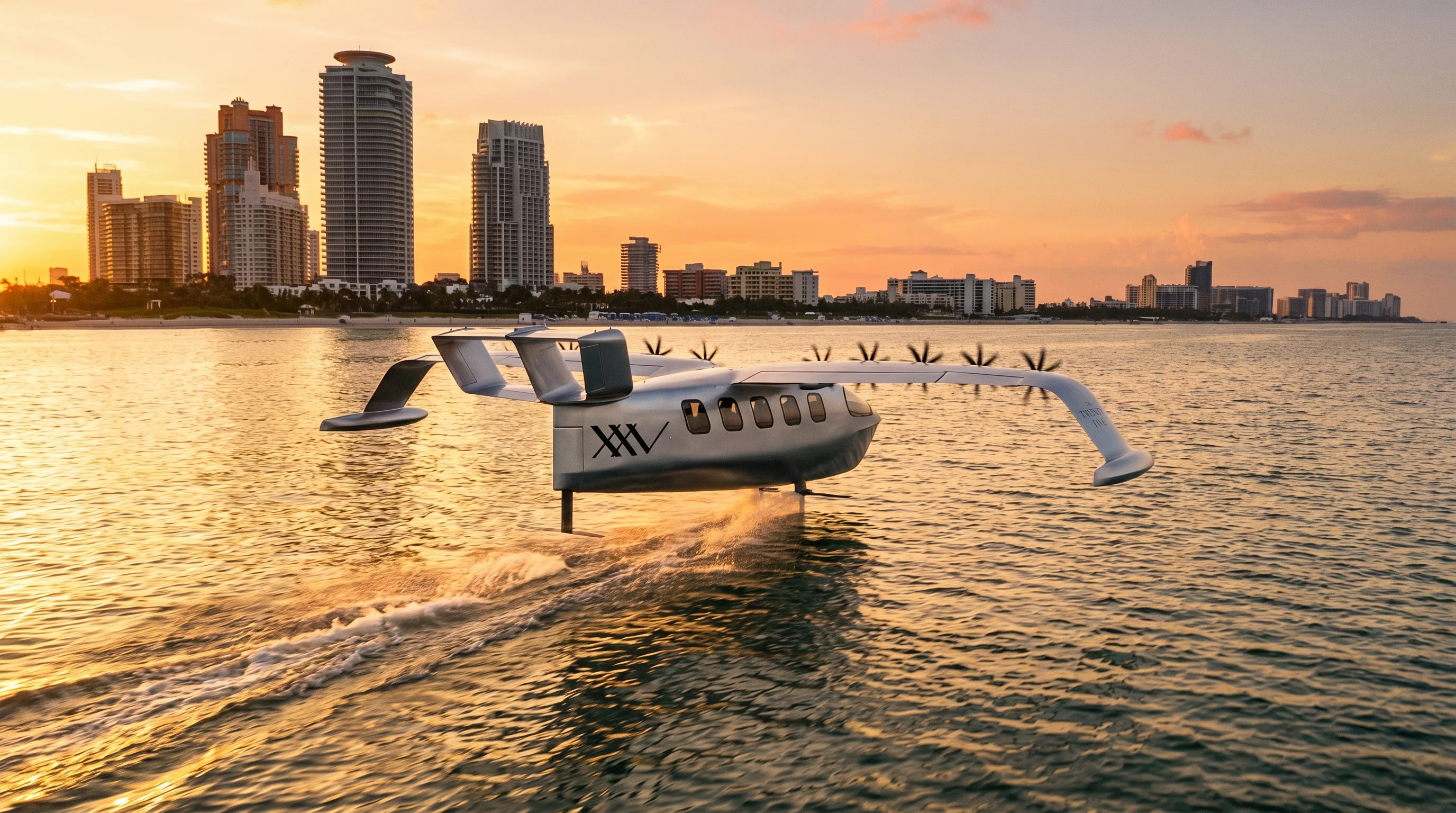
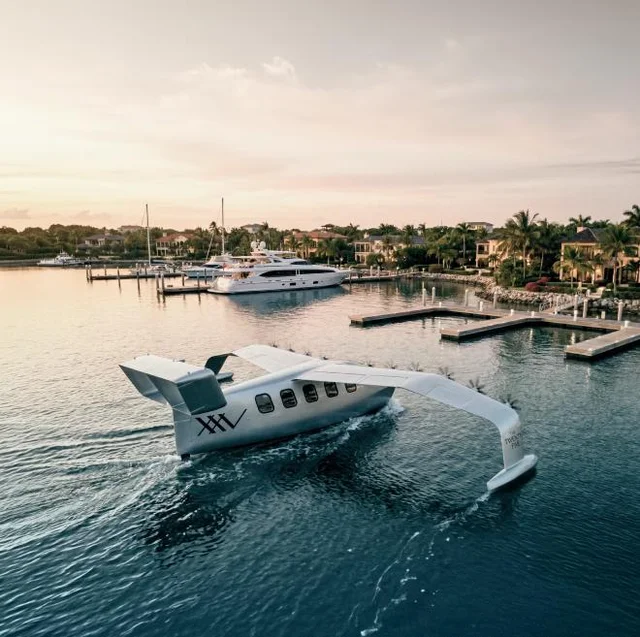
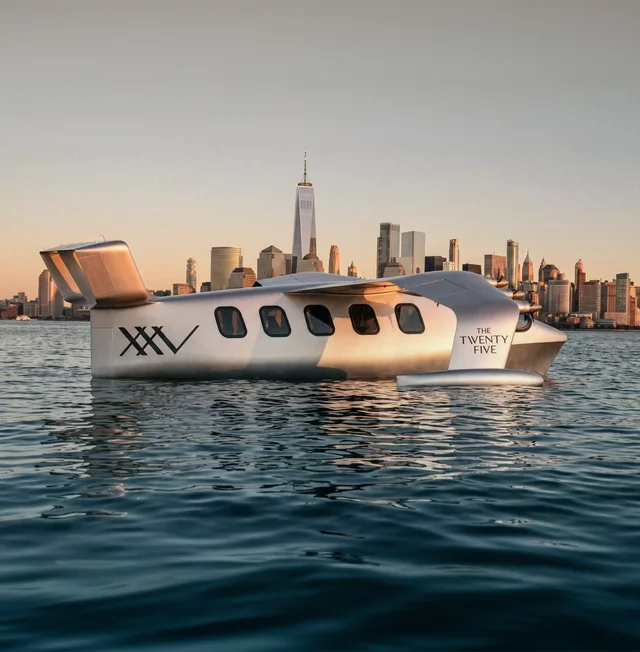
The Seaglider, which from the side looks a bit like a stubby seaplane without pontoons under the hull, has a big wingspan and is built of advanced composite materials. “It is one of the fastest foiling craft in the world with a top speed of 50 knots,” Thalheimer says. It will fly at a height of 30 feet, which he calls “the goldilocks zone” for maximum efficiency utilizing mother nature’s cushion of air — the same that seabirds use to glide effortlessly. While it does fly, in terms of regulatory bodies, it is considered a boat and is subject to US Coast Guard rules and regulation.
Powered by a line of 12 electric motors on the wings (and batteries under the floor), the Seaglider is more of a boat on the operational side too. Passengers embark at a dock. It then goes up on foil to provide a smooth cruise in busy coastal areas and finally flies in open areas. The initial range is 180 miles.
Since they found each other, The Twenty Five has become REGENT’s largest client with an order for up to 60 Seagliders (the largest outside of the military), with the goal to develop fleets on the East Coast as a first step. Recently, The Twenty Five struck a significant agreement with Hornblower, the largest passenger ferry operator in the US, who will take care of access to infrastructure, safety, crewing and operational licensing, among other aspects of day-to-day operations.
While the northeast is an obvious first step, between Manhattan and the Hamptons or Nantucket and Boston, the Seaglider’s operational profile is well suited to operate in South Florida, the Bahamas and other island nations. The craft is relatively easy to disassemble and reassemble, and so could conceivably be moved to where the demand is in early stages. Eventually, when production catches up, a full fleet of Seagliders could seamlessly be moving people in coastal areas where docks and charging stations are available.
The Twenty Five plans to launch the first charter-based Seagliders in late 2027, likely in South Florida, and as production ramps up, roll out scheduled service along the East Coast through 2028 and 2029.

News & Press
It delivers the speed of aviation with the serenity of the sea, enabling fast, seamless door-to-shore travel between luxury coastal corridors
August 10, 2026
July 09, 2026

June 16, 2026